Floor coating options, explained
What epoxy and polyaspartic actually are, where polyurea fits in, and what happens between bare concrete and a finished floor.
Which system fits your floor?
| Your floor | What matters | What to ask about |
|---|---|---|
| Garage, indoors | Hot tires, road salt, how soon you can park | Grinding, a flake or solid system, the topcoat, and the product's return-to-service times |
| Basement or lower level | Moisture coming up through the slab | Moisture testing and whether the slab needs a moisture-mitigating primer |
| Shop, barn or boat storage | Fuel, oil, dropped tools, wet floors | A thicker epoxy or quartz system with grit |
| Patio or pool deck | Sun and wet feet | A UV-stable topcoat and slip-resistant aggregate |
| Restaurant kitchen | Hot-water washdowns, grease | Urethane cement, built for thermal shock |
General guidance. Check the data sheet for the product being quoted.
What the three names mean
Epoxy
Two parts, resin and hardener, mixed on site. They react and cure into a hard plastic film. It comes as 100% solids (thickest, no solvent to evaporate), water-based (thinner, lower odor) or solvent-based. Epoxy bonds well and builds thick, which is why it is a common base coat. It is also rigid and it yellows in sunlight.
Cure time depends on the product and temperature. One manufacturer's garage product lists about 20 hours for the film to cure at 68°F, about 48 hours at 50°F, and about seven days at 68°F for full chemical and mechanical resistance.
Polyaspartic
Chemically it is an aliphatic polyurea. It cures fast, holds its color in sunlight and flexes more than epoxy. The catch is a short working time, often 10 to 20 minutes, so the installer has to move quickly. It is the usual topcoat in modern garage systems and the core of "one-day" installs.
Polyurea
The Polyurea Development Association defines pure polyurea as an isocyanate reacted with an amine-terminated resin. True polyurea is usually sprayed hot with special equipment and cures in seconds; think truck bed liners. The "polyurea" basecoats rolled onto garage floors are often hybrids. The word gets used loosely, so ask what's actually in the product.
Aromatic polyurea yellows in sun. Aliphatic polyurea, including polyaspartic, doesn't.
Other systems worth knowing
| System | What it is | Where it fits |
|---|---|---|
| Flake broadcast | Vinyl chips thrown into a wet base coat, then sealed with a clear topcoat | Garages, shops, showrooms |
| Quartz broadcast | Colored quartz sand in epoxy, often in layers, about 1/8 inch thick | Commercial kitchens, shops, wet areas |
| Metallic epoxy | Epoxy with metallic pigment worked into a marbled look | Basements, showrooms, bars |
| Urethane cement | Troweled urethane and cement hybrid that handles hot water and steam | Restaurant kitchens, breweries, food processing |
| Penetrating sealer | Silane or siloxane that soaks in and leaves no film | Driveways and outdoor slabs, on a budget |
| Polished concrete | The slab itself ground, densified and polished; no coating | Large dry commercial floors, retail, warehouses |
From bare slab to finished floor
- Look and measure. Size, cracks, stains, old coatings, how the floor is used.
- Test moisture where it matters. ASTM F1869 (surface emission) or F2170 (in-slab humidity). High readings mean a moisture-mitigating primer or a different plan.
- Profile the surface. Diamond grinding or shot blasting. The industry scale for roughness is ICRI's Concrete Surface Profile, CSP 1 (nearly smooth) to CSP 10 (very rough). Each product's data sheet names the profile it needs.
- Repair. Route and fill cracks, patch pits and spalls, deal with joints.
- Prime or base coat. Sometimes a moisture primer first.
- Broadcast. Flake, quartz or grit, if the system uses it.
- Topcoat. Clear polyaspartic, urethane or epoxy, with grit if it needs traction.
- Cure. Foot traffic, then vehicles, then full chemical resistance, each on the product's own clock.
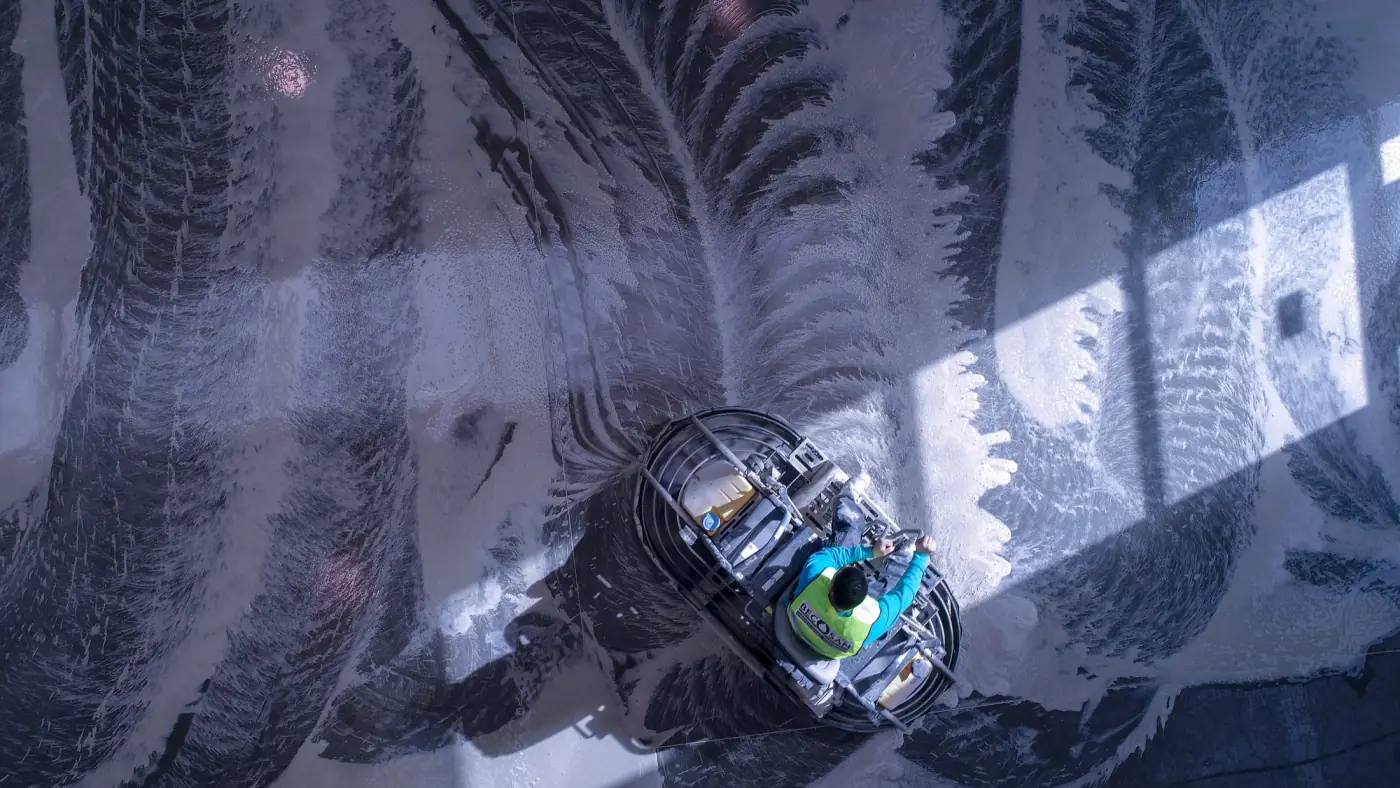
Acid etching is cheap and common in DIY kits, but it leaves a shallower, less even profile and has to be neutralized and rinsed. Grinding and blasting give a consistent profile the coating can lock into.
Promises to be careful with
"Lifetime" warranties. Read the exclusions. Some exclude moisture vapor, hydrostatic pressure, hot-tire staining and chemical stains. Delamination from moisture can show up two to four years in. A warranty is only as good as the company still being around to honor it.
Fixed lifespans. A coating's life depends on the slab, the prep, the product and the installer. A published lifespan is not a promise for your floor. Ask what the warranty covers for the proposed system.
"One-day" floors. Possible with fast chemistry. Ask whether moisture testing and any needed primer are part of that day.
Questions people ask
How long does a coated floor last?
Installer and cost-guide sources report ranges like 10 to 20 years for well-installed systems and 2 to 3 years for thin DIY kits. Those are industry-reported ranges, not guarantees. The biggest factor in early failure is prep: grinding, crack repair, and moisture.
What does "one-day" install mean?
Fast-curing polyaspartic and hybrid systems can be applied in a day. Ask whether the proposed schedule includes testing and any primer the slab needs, and what the warranty excludes.
What is "polycuramine"?
A Rust-Oleum brand name for a blend of epoxy, polyurethane and polyurea chemistry used in its RockSolid kits. It is a marketing term, not a separate chemistry class.
How do I clean a coated floor?
Sweep or dust-mop grit, then wash with a pH-neutral cleaner. Skip harsh acid or caustic cleaners. Rinse road salt off in winter. Follow the installer's care sheet for your product.
Know roughly what you want?
Request an estimate